
Foam board vs canvas: what is foam board and how does it differ from a canvas print?
Author: Alper Çimen, General ManagerPublished: 9 min read
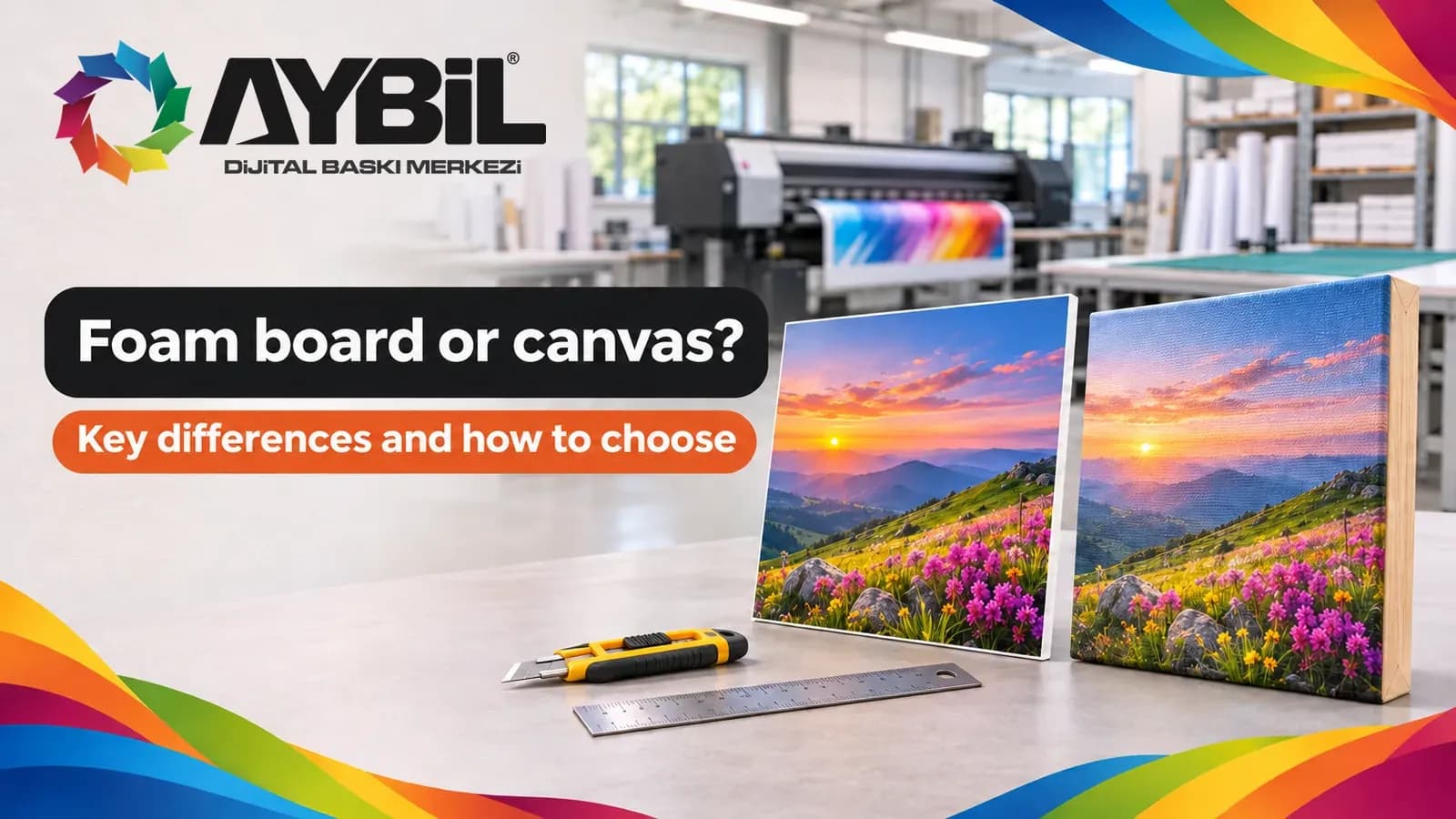
In short
Foam board vs canvas comes down to surface and use. Foam board (Turkish: fotoblok) is a foam sheet faced with card on both sides, with a print mounted on top; its flat, matte surface shows text and logos sharply and it is meant for indoors. A canvas print is fabric stretched over a wooden frame, looks like a painting and usually costs more.
- Foam board is a foam sheet faced with paper or card on both sides; once a print is mounted on it, it becomes a display board.
- A canvas print is printed on cotton or cotton-polyester fabric and stretched over a wooden frame; its textured surface softens the image.
- Paper-faced foam board does not stand up to water or wind; for outdoor use, PVC (Forex) board is the choice.
- Canvas usually costs more because it needs fabric, a specialised print process and a wooden frame.
Foam board, called fotoblok in Turkish, is a light, rigid sheet of polystyrene foam faced with paper or card on both sides [1][2]. Mount a printed poster on it and it becomes a board you hang on a wall or stand on a support [2].
For a business weighing foam board vs canvas, the real question is when foam board is the better pick. A canvas print is printed on fabric and stretched over a wooden frame, so it looks textured, like a painting [3]. Foam board gives a flat, matte surface, which is why text and logos come out sharp on it [4].
If you are ordering print for a shop, office, clinic or event, the choice rests on a few questions. Does the image carry text? How many months will it stay up? Is the room humid, or will it sit outdoors?
Say a clinic has just opened in Konya. It wants a permanent landscape image for the waiting room and a 50x70 cm campaign and wayfinding board for the entrance. Those two jobs go to two different materials, and you can follow why step by step below.
What is foam board?
Foam board is a sheet made of foam sandwiched between two matte cards, which keeps it both light and sturdy [2]. Internationally it is known as foam board or foamcore. The foam is usually polystyrene, and the outer faces are white clay-coated paper or brown kraft paper [1]. Some boards sold for photo mounting have an aluminium foil surface. These smooth, rigid sheets are used for large hanging signs and for framing photographs, and come in 5 mm and 10 mm thicknesses [5].
The same material lives in two separate worlds. Students and designers know it as model board: it is cut with a craft knife and glued for architectural models and dioramas [2]. There are also versions with black foam between black cards, and ones with a self-adhesive back [2].
On the print side, foam board is a carrier. The image printed on film is bonded onto the sheet with a laminating machine; add a stand at the back and it sits on a table, or hang it from the ceiling on fishing line [2]. The same Turkish source puts the common sheet at 5 mm thick in a 156x305 cm panel size [2]. Large print companies that sell printed boards also work with 5 mm foam and a matte surface [4].
A foam board print is an inexpensive piece of wall art [4]. It also works as a welcome sign at birthday parties and other events [4]. The campaign board at the clinic entrance is the same kind of indoor job. If you are curious about the print and the board together, our foam board prints page shows how the job is prepared.
What is a canvas print?
A canvas print is printed on cotton or cotton-polyester fabric coated for inkjet printing and then stretched over a wooden frame [6][7]. The face of the fabric gets a porous coating, which holds the ink close to the surface and improves sharpness and colour vibrancy [6]. As an example, one manufacturer's photo canvas is a cotton-polyester blend in which polyester makes up the larger share [8]. The fabric alone is 0.4 mm thick and weighs 240 grams per square metre, and the frame is made of spruce and pine [8].
Canvas, also known in Turkish as tuval, is a durable plain-woven fabric [9]. If the print is stretched so that it wraps around the edges of the frame, the piece can hang without a frame; this is called a gallery wrap [7]. With no glass in front, it does not reflect light either [3]. The clinic's landscape image should sit on the wall like a painting.
Foam board vs canvas: the differences
The most visible difference is the surface: canvas texture scatters light and softens the image, while the flat matte face of foam board shows fine text and sharp detail as they are [3][4]. Canvas texture can also mute colours slightly, so it does better with soft-toned images that do not rely on crisp detail [3]. Moisture, hanging and cost differences sit side by side in the table below.
| Criterion | Foam board | Canvas print |
|---|---|---|
| Material | Foam sheet faced with paper or card on both sides, with the print mounted on top [1] | Cotton or cotton-polyester fabric, wooden frame [6][8] |
| Surface and texture | Flat, matte; text and logos read clearly [4] | Textured; the image softens and looks like a painting [3] |
| Thickness and weight | Common thickness 5 mm, very light [4] | Fabric 0.4 mm and 240 g/m², most of the weight comes from the wooden frame [8] |
| Moisture and outdoors | Not resistant to water or wind, for indoor use [4] | One maker does not recommend humid rooms, high temperatures or outdoor use; 10-25 °C recommended [8] |
| Hanging | Hung with adhesive wall strips or placed on an easel [4] | Hangs without a frame thanks to the stretcher [3] |
| Cost | Sold as a budget-friendly wall option [4] | Usually more expensive because of fabric, specialised printing and the frame [10] |
The reason behind the cost row lies in the materials. Canvas is a quality fabric that needs a specialised printing technique and often comes with a wooden frame, and these push the total price up [10]. With foam board, most of the cost is the print and the foam sheet.
Since the exact price changes with size, quantity and finish, the soundest approach is to get quotes for both products at the same size for your own job and compare them.
The weight difference also decides how each one is hung. Foam board is light enough to fix to a wall with adhesive strips without leaving marks [4]. A canvas, with its frame, has to go up with screws or a hanging kit.
When should you choose which?
Foam board suits jobs where text and logos must read clearly, because its surface is flat and matte [4]. Canvas stands out for decor that should look like a painting [3]. Our own advice is foam board for boards that change with each campaign and canvas for decor that will stay up for years. You can decide by the type of setting like this:
| Use | Recommended | Why |
|---|---|---|
| Shop campaign board, window display | Foam board | Prices, text and logos read clearly on the flat matte surface [4]; it is a light sheet used for hanging signs and displays [5] |
| Trade fair stand, wayfinding sign | Foam board | Light to carry, set up on a stand or a hanger [2] |
| Wedding and event welcome board | Foam board | Sits on an easel; guests write notes on it with a permanent marker and it is kept like a guest book [4] |
| Office and clinic wall decor | Canvas | Stays up for a long time, looks like a painting [3][7] |
The board at the entrance will carry campaign text, a phone number and a logo, and in a few months it will be replaced with a new one. Canvas texture would soften that small type, and you would be paying for a frame and fabric on a job that is going to change. The right material here is flat, matte foam board [4].
The landscape in the waiting room, on the other hand, will stay in the same spot for years and has no sharp text. The softness the texture brings stops being a flaw in this image and becomes the effect you want; a framed canvas is the better choice here [3][7].
There is a shared limit too. A damp spot such as next to a sink suits neither of them. Paper-faced foam board is not water-resistant, and one canvas maker does not recommend its product for humid rooms [4][8]. If the clinic needs an information board on a wall close to a wet area, look at the polyvinyl chloride (PVC) board described below.
Special cases: Forex (PVC) foam board and outdoor use
Outdoors or in humid settings, PVC foam board replaces paper-faced foam board; it is sold as Forex or foamex and suits both indoor and outdoor use [11]. Two different boards are sold under the name "foam board". One is the paper-faced foam this article covers, which is for indoors [1][4]. The other is a semi-expanded PVC board with a hard white surface [11]. That is why it matters to ask which one is being priced when you request a quote.
PVC board is usually made in 3, 5 and 10 mm thicknesses. 3 mm is recommended for temporary displays and promotional work, 5 mm for indoor and outdoor jobs that need extra rigidity, and 10 mm for the most durable signs [11]. The largest size that can be printed on a single panel is 150x290 cm [11]. Larger images are split across several panels [11]. PVC boards printed directly with ultraviolet (UV) ink become resistant to water and light. One manufacturer says directly printed boards are also suitable for sheltered outdoor areas [12]. Laminated PVC boards are also sold as protected against water and scratches [12][13].
For a campaign board outside your shop door, an open-air trade fair area or an information sign next to the clinic sink, ask for PVC board. For a sign that will face constant sun and rain, settle the board thickness and surface protection at the quote stage as well.
Cleaning a canvas print and cutting foam board
You can wipe a canvas print: one manufacturer recommends a damp or dry microfibre cloth, pressing very lightly to avoid scratches [8]. Scrubbing with a wet cloth or using detergent falls outside that advice. According to one photography publication, a protective varnish can improve a canvas's colour vibrancy and sharpness [3].
Foam board cuts easily with a craft knife or cutter (Turkish: kretuar) [2]. The material is known as a sheet that is easy to cut [1]. For a clean edge, hold the ruler steady and take the blade through in several light passes; pressing down in one go crushes the foam. When gluing, watch one point: the foam melts with some adhesives, such as cyanoacrylate glue (Turkish: japon yapıştırıcısı), and with some paints. Water-based glues can also warp the paper face; the best results usually come from a good spray adhesive [1]. Styrofoam adhesives are also used for models [2].
If, like the clinic in Konya, you are ordering two jobs at once, write down the size of each piece, where it will hang and whether the room is humid when you place the order. Ask for foam board for the entrance board, canvas for the landscape in the waiting room and PVC board for a sign near a wet area. A file prepared with this information lets you compare the price of all three materials at the same size through our large format printing service.
Frequently asked questions
What is model-making foam board?
Model-making foam board (Turkish: maket kartonu) is the same kind of material as fotoblok: a light sheet with foam pressed between two layers of card. It is cut and glued for architectural models and dioramas, and once a print is mounted on it, it becomes a display board.
What does the price of model-making foam board depend on?
The price depends on the sheet size, thickness, colour and the quantity you buy. Printed foam board adds printing and cutting on top, so the most accurate figure comes from a quote that states size and quantity.
Is a foam board print the same thing as a foam board sheet?
No. A foam board sheet is unprinted foam card; a foam board print is the rigid board you get when a printed poster is mounted onto that sheet.
This article is part of “Digital print and marketing”.
Sources
- Vikipedi (İngilizce), Foamcore maddesi · Wikimedia Foundation, Inc, 2005-05-02
- Forum Sitesi, Fotoblok maket kartonu nedir? · IPTV Forum - Webmaster Forum ve Genel Forum | Forum Sitesi
- Kanvas mı kâğıt mı: fotoğraf baskısı için malzeme seçimi (2024) · PetaPixel, 2024-11-04
- Köpük levha baskı ürün sayfası · Vistaprint
- Metro Imaging, Kapa levhaya montaj (2017) · Metro Imaging Ltd, 2017-01-31
- Rochester Teknoloji Enstitüsü (RIT) Image Permanence Institute, Dijital Baskı Koruma Portalı: Kanvas dokusu sözlüğü · DP3: Digital Print Preservation Portal
- Vikipedi (İngilizce), Kanvas baskı maddesi · Wikimedia Foundation, Inc, 2006-10-30
- Foto kanvas teknik özellikleri · Saal Digital
- Vikipedi (Türkçe), Kanvas kumaşı ve tuval maddesi (2022) · Wikimedia Foundation, Inc, 2022-09-23
- Kanvas ve poster baskı karşılaştırması · Gelato
- Foamex (PVC) levha baskı ürün sayfası · Pixartprinting
- Fotoğraf panosu (Forex) ürün sayfası · MYPOSTER
- Forex köpük levha baskı ürün sayfası · Custtom
- #foam board
- #canvas print
- #foamcore
- #Forex PVC board
- #digital printing
Ask us about this on WhatsApp
Send your file on WhatsApp or by email. We'll plan the delivery around your job.